African Ancestry Family Story That Survived Slavery
The Clue That Survived Slavery and Preserved My African Ancestry Family Story
It survived slavery.
It survived generations.
It survived adoption.
Yet my family carried a clue across more than a century of separation.
Even so, this African ancestry family story survived slavery, generations, and adoption.
In fact, it endured even when people no longer understood what it meant.
Nevertheless, it survived people who no longer understood what it meant.
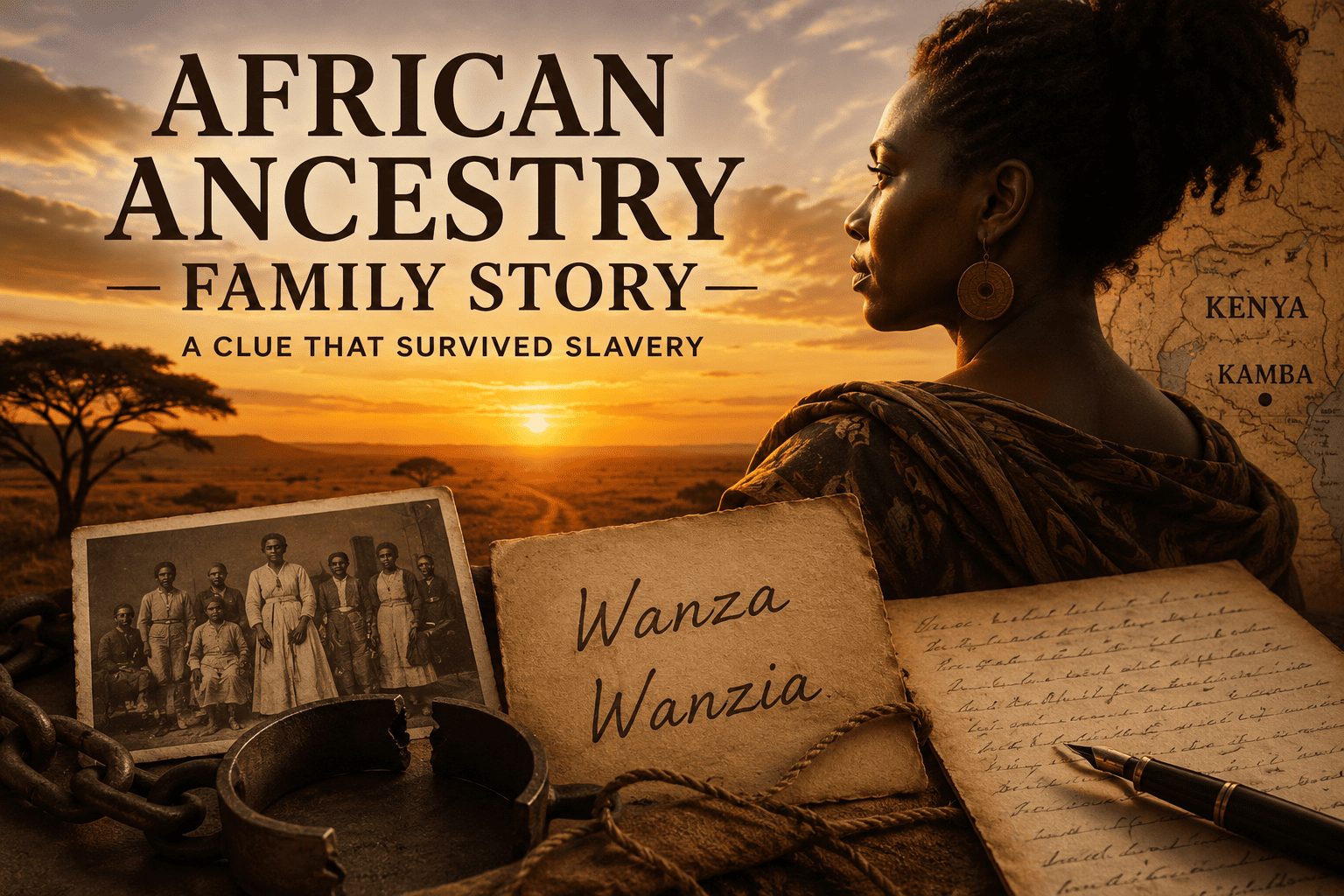
At its heart, this African ancestry family story began with a single clue.
The clue was a single name.
Wanza.
When I first heard that name, I thought it was simply part of an old family story.
However, decades later, I moved to Kenya and discovered that Wanza and Wanzia were still living names among members of the Kamba people.
As a result, that discovery changed how I understood my ancestry forever.
More importantly, it taught me something I believe many people in the African diaspora need to hear:
The clues were not always lost.
Instead, we sometimes fail to recognize them.
Reconnecting With a Family I Never Knew—and a Heritage I Had Lost
I was adopted as a child through a closed adoption.
For most of my life, my biological family existed only as unanswered questions.
As a result, I did not know where I came from.
In fact, I did not know my family history.
More importantly, I did not know the people whose struggles, sacrifices, and victories made my life possible.
Then, against the odds, I found my way back.
First, I reconnected with my birth mother.
Next, I found my birth father.
Eventually, I met my grandfather, Roy Williamson.
Looking back, those meetings felt less like introductions and more like recovering missing chapters from a book.
With each encounter, every conversation revealed something new.
Similarly, every relative carried a piece of a larger story.
As a result, every story filled a gap I didn’t know existed.
One day, my grandfather invited me on a road trip.
We drove from Chanute, Kansas, to Eufaula, Oklahoma.
Along the way, he told stories about our family, our ancestors, and the people who came before us.
I listened carefully.
Meanwhile, I brought a video camera.
At the time, I thought I was documenting family history. Years later, I learned that many families use resources such as FamilySearch to preserve and verify family records.
However, I didn’t realize I was preserving evidence.
Standing on Wanza’s Land: An African Ancestry Family Story
When we arrived in Eufaula, my grandfather took me to a piece of land that had been in our family for generations.
A cousin was still living there.
The Oklahoma sun was beginning to settle as we stood looking across the property.
My grandfather pointed across the land.
“This was Wanza’s.”
I remember looking out across the farm and realizing that the story wasn’t theoretical.
It wasn’t an idea.
It wasn’t a legend.
It was physical.
We were standing on it.
Approximately 260 acres.
Land that, according to the family history passed down through generations, had been acquired by Wanza Gregory after Emancipation.
At that moment I wasn’t thinking about genealogy.
I wasn’t thinking about Africa.
I wasn’t thinking about tribes.
I was thinking about one simple fact.
This was proof.
Proof that a man who had survived slavery had gone on to build something substantial enough that his descendants were still standing on it generations later.
I filmed the land.
I filmed my grandfather.
I interviewed relatives.
I recorded stories.
Today many of the people in those recordings are gone.
But their voices remain.
Captured on videotape.
Preserved for future generations.
Decades later, I would realize those recordings contained more than family memories.
They contained clues.
Why This African Ancestry Family Story Never Disappeared
The central figure in my grandfather’s stories was an ancestor named Wanza Gregory.
According to the family history passed down through generations, Wanza was taken from East Africa and enslaved in America.
After Emancipation, he accomplished something extraordinary.
My grandfather explained that Wanza gathered his family, livestock, and possessions onto a boxcar and traveled west.
Eventually he settled in Eufaula, Oklahoma.
There he acquired farmland and established what became the family farm.
The story fascinated me.
Not because it appeared in textbooks.
Not because it was famous.
But because it represented something larger.
How does a man rebuild after slavery?
How does someone move from bondage to ownership?
How does someone create a legacy when every force around him was designed to prevent exactly that?
The answer is difficult to summarize.
But one word comes close.
Resilience.
Wanza Gregory became a symbol of what is possible when people refuse to surrender their future.
And he was not alone.
Not far from Eufaula, communities like Black Wall Street would later demonstrate the same spirit of enterprise, cooperation, and determination.
These stories challenge a narrative that is too often incomplete.
Slavery caused enormous destruction.
But it did not erase the human capacity to build.
Wanza Gregory was one of those builders.
Families preserve more history than they realize.
Sometimes the most important records are not stored in archives.
They survive in stories.
The Witnesses Who Preserved My African Ancestry Family Story
One reason this story remained so important to me is that I did not receive it from a website, a genealogy database, or an online ancestry search.
I heard it directly from my grandfather while standing on land he said had been acquired by Wanza Gregory.
I recorded those conversations on videotape.
I interviewed relatives who repeated the same story.
I visited the place they described.
I met family members connected to it.
The story was not merely something I read.
It was something I witnessed.
Today those recordings remain among the most valuable historical records my family possesses.
The Clue Hidden in Plain Sight That Revealed My African Ancestry
Years passed.
I stored the videotapes.
I carried the story with me.
And life continued.
Yet one thing remained unresolved.
The name.
Wanza.
For generations, family members knew the name.
They repeated it.
They remembered it.
But nobody seemed to know where it came from.
Nobody knew what it meant.
Nobody knew whether it connected to a people, a language, a place, or a tribe.
The story survived.
The meaning did not.
Or so we thought.
Because I had been separated from my biological family through adoption, I didn’t hear the story until I was around thirty years old.
Even then, I saw it primarily as family history.
I never considered that the name itself might contain information.
I never imagined it could become a bridge connecting continents.
Then I began asking a different question.
What if the name wasn’t just a name?
What if it was a fragment?
What if it had survived longer than the records?
What if the clue had been sitting in plain sight the entire time?
The Earthquake That Changed My African Ancestry Family Story
In March 2025, while living in Bangkok, Thailand, I experienced the massive 7.7 Myanmar earthquake.
The experience changed me.
What happened afterward did not feel like ordinary creativity.
Instead of isolated ideas arriving one at a time, complete books, systems, frameworks, music concepts, and organizational models appeared already connected.
For weeks I documented what I was experiencing.
I wrote constantly.
Mapped systems.
Outlined books.
Recorded concepts.
Built frameworks.
The volume and interconnected nature of the information was unlike anything I had experienced before.
Whether someone interprets that as intuition, inspiration, pattern recognition, a spiritual experience, or something else entirely is their choice.
I can only describe it honestly.
It felt less like invention and more like discovery.
Among the names that repeatedly surfaced during that period were Wanza and Wanzia.
At the time, I did not fully understand why.
Three months later, I moved to Nairobi, Kenya.
When the Name Appeared Again in My African Ancestry Family Story
Soon after arriving in Kenya, I began building Wanzia.
I posted job opportunities and started reviewing applications.
Then something happened that immediately caught my attention.
The names started appearing.
Wanza.
Wanzia.
Again.
And again.
And again.
These weren’t references to my company.
These were people’s actual names.
The pattern became impossible to ignore.
So I began investigating.
I asked questions.
I researched the names.
I spoke with local people.
Eventually I learned something that shocked me.
Wanza and Wanzia are names associated with members of the Kamba people of Kenya.
The moment I learned that, my mind immediately returned to Oklahoma.
To my grandfather.
To the farm.
To the videotapes.
To the stories that had been sitting quietly in storage for decades.
Suddenly they didn’t feel like stories anymore.
They felt like evidence.
The clue no longer seemed random.
It seemed alive.
“I’m Kamba”
Excited by the discovery, I started telling everyone.
“I’m Kamba.”
Most people laughed.
Some were curious.
One day I mentioned it to a woman I was dating.
She looked at me and said:
“I’m Kamba.”
I laughed.
Then she introduced me to family members.
Family members introduced me to elders.
Conversations became relationships.
Relationships became invitations.
And eventually something happened that I never expected.
Welcomed Back
After hearing my story and learning about the connections I had uncovered, Kamba elders formally welcomed me back into the tribe through a traditional ceremony.
This was not a symbolic gesture.
It was a real ceremony.
Elders were present.
A goat was sacrificed according to local custom.
A communal meal followed.
The event was documented through photographs and video recordings.
For someone raised in the United States with no understanding of African tribal identity and no knowledge of where his ancestors may have originated, the experience was profound.
I had spent decades searching for pieces of my story.
Then I found my family.
I carried the story of Wanza Gregory.
Then I found the name again in Kenya.
Now I was sitting with elders acknowledging a connection I had spent much of my life trying to understand.
Whether viewed through ancestry, culture, lineage, identity, or community, it remains one of the most meaningful experiences of my life.
What the Diaspora May Be Missing
The lesson I took from this experience is larger than my own story.
Many people in the African diaspora believe all connection to Africa was erased.
Some of it was.
But not all of it.
Slavery fragmented the map.
It did not erase every coordinate.
Across the world, families still carry fragments.
A surname.
A family story.
An elder’s memory.
A photograph.
A place.
A recording.
A clue.
The challenge is not always that the clues disappeared.
The challenge is that we often fail to recognize them.
For generations, my family carried the name Wanza.
The clue survived.
But nobody knew it was a clue.
If a single name could survive slavery, separation, adoption, and more than a century of history, perhaps other families are carrying similar fragments.
Perhaps the challenge facing the diaspora is not the complete loss of identity.
Perhaps it is learning how to recognize the pieces that remain.
The Clue Survived
When my grandfather first told me the story of Wanza Gregory, I thought I was hearing family history.
Today I understand that I was receiving something else.
A clue.
A clue that survived slavery.
A clue that survived separation.
A clue that survived adoption.
A clue that survived generations.
For more than a century, my family preserved a name without understanding its meaning.
Wanza survived.
The story survived.
The memory survived.
The clue was never lost.
We simply didn’t know it was a clue.