African Ancestry: Stories Across Generations
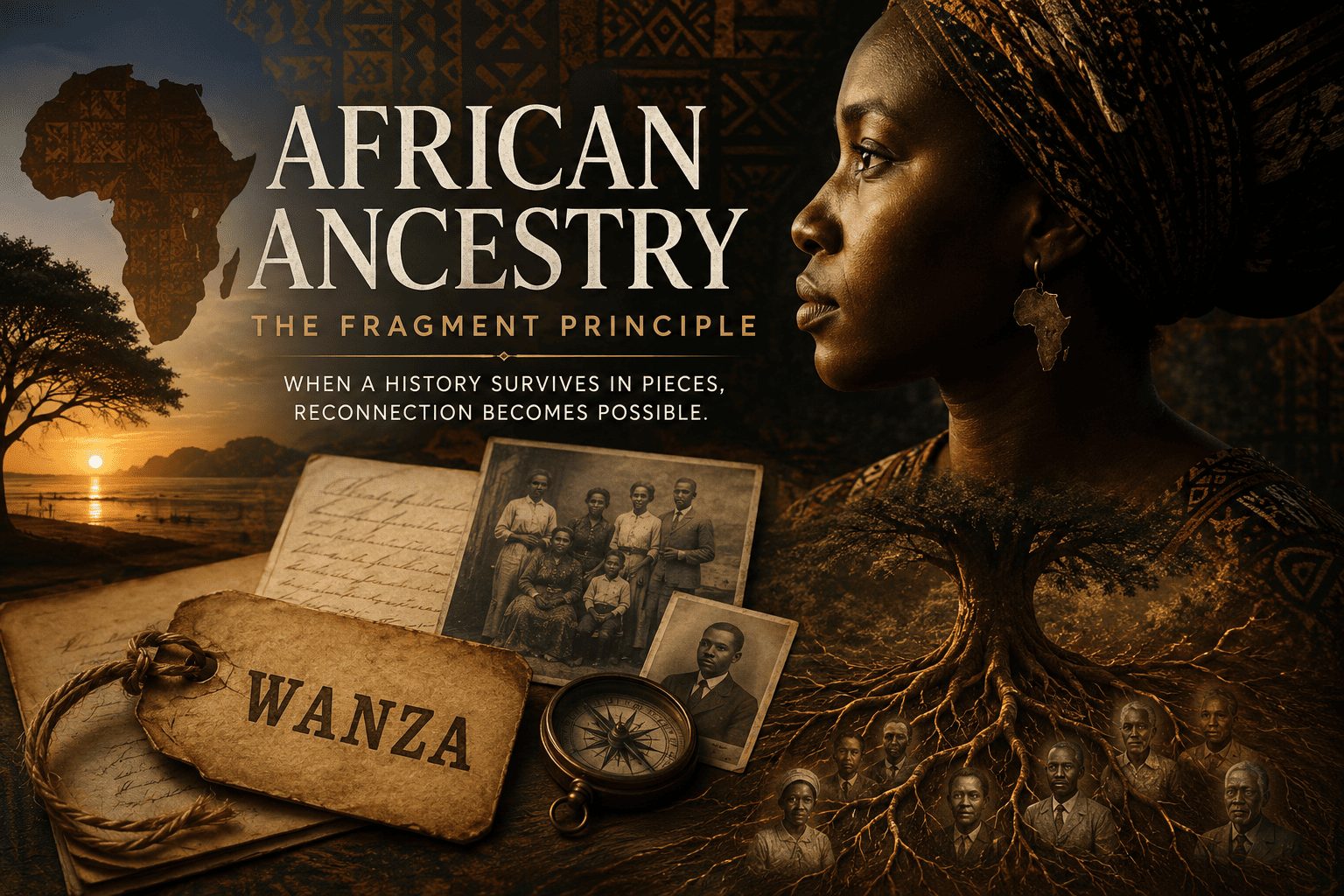
African Ancestry: The Fragment Principle
African Ancestry can often be preserved in ways that are not immediately understood.
For more than a century, my family preserved a name without understanding it.
Wanza.
The name survived.
However, the explanation did not.
Generations repeated it.
Generations remembered it.
Yet, despite this repetition, nobody seemed to know where it came from, what it meant, or why it mattered.
Years later, I would discover that this wasn’t simply a family story.
Instead, it was a pattern.
More specifically, a pattern that may help explain why so many people across the African diaspora feel disconnected from their past.
In essence, the fragment survived longer than the explanation.
Once I understood that, I began seeing it everywhere.
African Ancestry: The Mistake We Make About History
Most people believe history is either preserved or lost.
Either the records survive.
Or they disappear.
Either the story remains intact.
Or it vanishes forever.
However, reality is rarely that simple.
In fact, history usually disappears in stages.
A document is lost.
Then a photograph fades.
A language is forgotten.
An elder passes away.
A family moves.
And a tradition continues even after nobody remembers why it began.
As a result, the story becomes incomplete long before it becomes invisible.
What survives are fragments.
Therefore, this is where most people make a critical mistake.
They mistake fragmentation for disappearance.
Yet those are not the same thing.
African Ancestry: The Real Enemy Is Not Loss
The dominant story of the African diaspora is often a story of loss.
Lost names.
Lost languages.
Lost cultures.
Lost histories.
Undeniably, there is truth in that story.
However, there is another truth that receives far less attention.
Many things were not lost.
Instead, they were disconnected.
The real tragedy is not always that history disappears.
Rather, sometimes the tragedy is that history survives but nobody recognizes it.
For example, a family repeats a story without understanding its significance.
Similarly, a name survives while its meaning disappears.
Likewise, a tradition continues after its origin has been forgotten.
In each case, the fragment remains.
Meanwhile, the context vanishes.
And without context, even preserved history can feel lost.
African Ancestry: The Fragment Principle
This is the Fragment Principle:
When a complete history cannot survive, fragments often do.
As a result, those fragments become carriers of memory.
A fragment may be:
A surname
A family story
A place name
A photograph
A recipe
A tradition
A recording
An elder’s memory
A single word
Most fragments do not look important.
Consequently, that is why they survive.
People preserve them without realizing what they are carrying.
The information survives.
But the explanation fades.
Yet the fragment remains.
Waiting.
African Ancestry: Why Families Miss Their Own Clues
The greatest threat to a fragment is not destruction.
Instead, it is familiarity.
People stop seeing what has always been there.
For instance, the story everyone has heard a hundred times.
Or the nickname nobody questions.
Or the photograph nobody investigates.
Or the place name that appears in every family conversation.
Or the name everyone remembers but nobody examines.
Over time, these things become invisible precisely because they are ordinary.
Yet, ordinary things often contain extraordinary information.
My family preserved the name Wanza for generations.
However, nobody recognized it as a clue.
Which raises a difficult question:
How many other families are doing the same thing today?
The Fragment Survived Longer Than The Explanation
The longer I studied family history, oral history, and diaspora identity, the more I encountered the same pattern.
The fragment survived longer than the explanation.
For example, a family remembers a surname.
But not where it originated.
Similarly, a community preserves a tradition.
But not why it began.
Likewise, a people remember a story.
But not the context that once made it meaningful.
This pattern appears so often that it begins to look less like coincidence and more like a law.
Fragments are resilient.
By contrast, explanations are fragile.
Therefore, the fragment often outlives the explanation.
Recognition Changes Everything
Most people assume reconnection begins with discovery.
However, I no longer believe that.
Instead, I believe reconnection usually begins with recognition.
The clue already exists.
The fragment is already present.
The story has already survived.
What changes is awareness.
At some point, someone asks a new question.
Then someone notices a pattern.
Then someone becomes curious.
Suddenly, the ordinary becomes significant.
A fragment becomes a clue.
And a clue becomes a path.
The Four Stages Of Reconnection
Across many forms of identity recovery, I see the same sequence.
First, Fragment
Something survives.
A name.
A story.
A place.
A memory.
Then, Recognition
Someone realizes it may matter.
Next, Investigation
Questions are asked.
Stories are compared.
Connections are explored.
Finally, Reconnection
The fragment regains context.
Meaning returns.
What was isolated becomes connected.
Most people spend their lives searching for answers.
However, few realize they may already possess the clues.
Beyond Family History
The Fragment Principle extends beyond ancestry.
For instance, organizations inherit fragments.
Communities inherit fragments.
Cultures inherit fragments.
Civilizations inherit fragments.
Ideas survive after the systems that created them disappear.
Values survive after people forget where they came from.
Traditions survive after their purpose has been lost.
As a result, the future is often built from pieces of the past that were never fully understood.
The individuals, communities, and civilizations that thrive are often those that learn how to recognize what survived.
What Fragments Survived In Your Family?
Perhaps it is a surname.
Perhaps it is a story told by a grandparent.
Perhaps it is a photograph nobody can explain.
Perhaps it is a place your family always talked about.
Perhaps it is a tradition whose origin has been forgotten.
Or perhaps it is something so ordinary that nobody has ever questioned it.
Yet.
Most fragments do not announce their importance.
Instead, they wait.
Waiting for someone to recognize them.
Waiting for someone to ask a different question.
Waiting for context to return.
The Fragment Principle (Conclusion)
For more than a century, my family preserved a name without understanding its significance.
Wanza.
The name survived.
However, the explanation did not.
That experience taught me something larger than ancestry.
The fragment survived longer than the explanation.
If that can happen within a family, it can happen within a culture.
If it can happen within a culture, it can happen within a people.
And if it can happen within a people, it can happen within a civilization.
Every family inherits fragments.
Every generation decides what happens to them.
Ultimately, the future does not belong only to those who discover something new.
Rather, the future belongs to those who learn how to recognize what survived.